The Next Generation of Fire Protection Technology
BACring — Powerful control system for fire protection and smoke extraction systems
All about BACring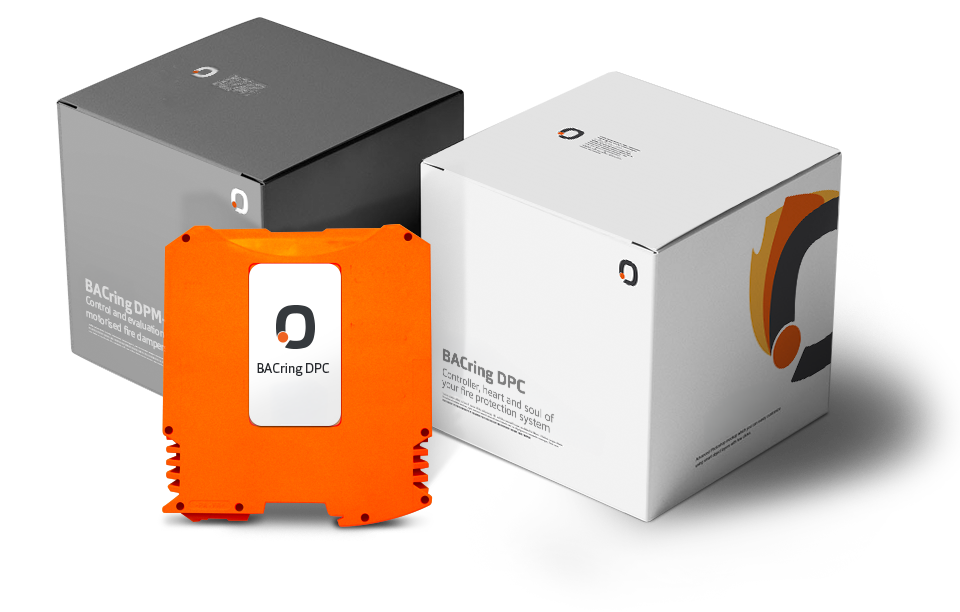
BACring is a ring-shaped, BTL-certified* system for centralized monitoring and controlling fire protection and smoke extraction dampers.
It demonstrates its strengths particularly in large buildings such as hospitals, hotels, government facilities, and other commercial and industrial buildings with up to 10,000 data points. As part of the building technology and automation, the system can be flexibly expanded with functions and components such as sensor data transmission or light and escape route control.
The construction of BACring increases the safety of people and goods worthy of protection. It can also be used cost effectively and resource efficiently.
Consultation
Now Available: The DPM-M2A2 Analog Fieldbus Module. Bridging the Gap Between Control and Safety Technology
Step into the future with our next-generation module, which processes analog signals at two input and output points. This makes the fieldbus module ideal for controlling airflow regulators or actuators. Thanks to its flexible configuration, it can also be used for evaluating and controlling all types of analog signals, such as temperature sensors and valves.
BACring can do that
Important properties at a glance
-

Distances of up to 5,000 m per DPB-Buscontroller possible (20 km in total)
-

Control of up to 2,500 data points per DPB-Buscontroller (total 10,000 DP)
-

Operation via encrypted web interface
-

Robust ring bus topology
-

Independent self-diagnosis with error localization and handling
-

High tolerance for short circuiting, reverse polarity, and power failure (UPS)
-

Central and efficient energy supply via ring bus
-

Fast response in the millisecond range
-

Redundant design of both DPC and DPB controllers for increased system reliability
-

BACnet/IP & Modbus TCP
-

Expandable for future BMS needs and applications
-

Open for future interfaces such as OPC/UA